One of my favorite turns of the wheel through the year is the Autumnal Equinox. This year the Autumnal Equinox occurs on September 22nd, but in ancient times these turns of the seasons were big celebrations that lasted much longer than one day. Equinox translates to “equal night,” that moment when we come into a sense of equilibrium between the intense light and action of summer and the waning light and more reflective time of autumn and winter. I have always loved this time of year, although autumn can be somewhat elusive here in Colorado. Sometimes the calendar says Fall and Colorado says, “How about 85 degrees?” I can still pretend.
I have written about the Autumn Equinox many times over the years, and when I went back and reread those older articles, I realized that I still believe most of what I wrote. What has changed is my understanding of what it means to come back into balance.
I don't think balance means everything gets an equal amount of our time, energy, or attention. Nature certainly doesn't operate that way. The Equinox itself is only a moment of balance. The light doesn't stop there. From here the nights continue to grow longer, the temperatures begin to cool, plants start sending their energy down into their roots, leaves change color and eventually fall, and what was gloriously outward and abundant during summer begins its movement inward.
Maybe what I am seeking these days isn't balance as some perfect 50/50 state at all. Maybe it is equanimity, the ability to remain rooted and connected to ourselves while everything around us continues to change.
That feels particularly important to me this year because there is A LOT happening in our world. There are so many stories competing for our attention, outrage, worry, fear, and energy, and so many opportunities to become completely external. I don't believe the answer is to disconnect from any of it or stop caring about what happens beyond our own little lives. We belong to communities. We belong to one another. But I also know what happens to me when I become too external. I start paying attention to the wrong things. I become reactive. I get a little snarky and short and find myself wanting to respond to things that really are of no concern to me. And eventually my body, my Inner Wisdom, or usually both say, Enough. Come back.
I have always felt that call particularly strongly at the end of summer. I can feel the shift from the fiery action and expansion of summer into the cooler, darker dreamscape of autumn in my body, mind, and spirit. There is a desire to pause, to reflect, to be a little quieter and listen more deeply. I think most of us feel it whether or not we consciously identify it as seasonal. It is in rhythm with something much older than our calendars, schedules, algorithms, and endless to-do lists. And yet most of us resist it. We ignore the whispers and move directly from the activity of summer into the activity of the holidays, and then wonder why we are completely exhausted by January.
So I am going to invite you to be a little rebellious and don't ignore the pause.
But before you decide what needs to change, be fixed, released, reorganized, healed, delegated, or put on another damn list, take some time to celebrate the harvest. Look back at the seeds you planted last spring, and perhaps even last autumn, and notice all you have done and become. Sit in deep gratitude for those things that came to fruition, and yes, even those things that didn't or perhaps died on the vine. Some things simply weren't meant to be in this particular season of your life. Some seeds don't sprout. Some things we desperately wanted six months ago turn out not to be what we want now. That doesn't make the season a failure.
Harvest isn't only about measuring what grew. It is also about noticing what actually happened and celebrating what needs to be celebrated and also grieving what needs to be grieved.
What surprised you this year? What grew that you weren't expecting? What did you learn? Who showed up? What did you create? What relationship deepened? What became clearer? What did you finally stop doing? Where did you become more fully yourself? And who helped you?
That last question matters because abundance isn't an individual accomplishment. There are people who opened doors for us, listened to us, fed us, challenged us, bought something from us, taught us, loved us, picked up the phone, showed up at exactly the right moment, or simply sat beside us while something was hard. One of the things I wrote in an older Equinox article was to thank the people who supported you throughout the year, honor the ancestors and teachers who came before you. That is a core value of mine, but most of us didn't "make this stuff up". Harvest belongs to community too.
Maybe your Equinox celebration is simply inviting some of those beloveds—blood family, soul family, friends, neighbors—to the table. Make soup. Bake some bread. Eat grains and roots and the foods that are actually being harvested around you. Light candles. Put the damn phones away. Tell each other what you are grateful for and what you are celebrating.
That counts as ceremony.
And because I am me, of course there are going to be plants involved.
I am especially drawn to hawthorn, rosemary, calendula and beet root for this Equinox. Hawthorn is one of our great heart herbs, traditionally used as a cardiovascular tonic, but I also love the energetic teaching of a plant that holds beautiful berries among thorns. There is something there for me about remaining openhearted while also having boundaries, especially when so much in the world is constantly asking for a piece of our attention and emotional energy.
Rosemary brings another kind of medicine. It is aromatic, warming and stimulating, traditionally used to support circulation and digestion, and its long relationship with memory and remembrance makes it beautiful for a harvest ritual. Not necessarily the deeper ancestor work—we'll get there in October—but simply remembering. What happened this year that you do not want to forget? What lesson do you want to carry with you? Who helped you become the person standing here now?
Calendula feels like the last bit of summer sunlight we can carry across the threshold. We know it as a wonderful topical herb for soothing and supporting the skin and tissues, but just LOOK at it. Those brilliant yellow and orange flowers are tiny suns. I love having calendula on an Equinox table as the light and dark meet, almost as a reminder that we aren't rejecting the light as we move toward darkness. We carry what it gave us forward.
And then there is beet root, which has really been calling to me for this Equinox.
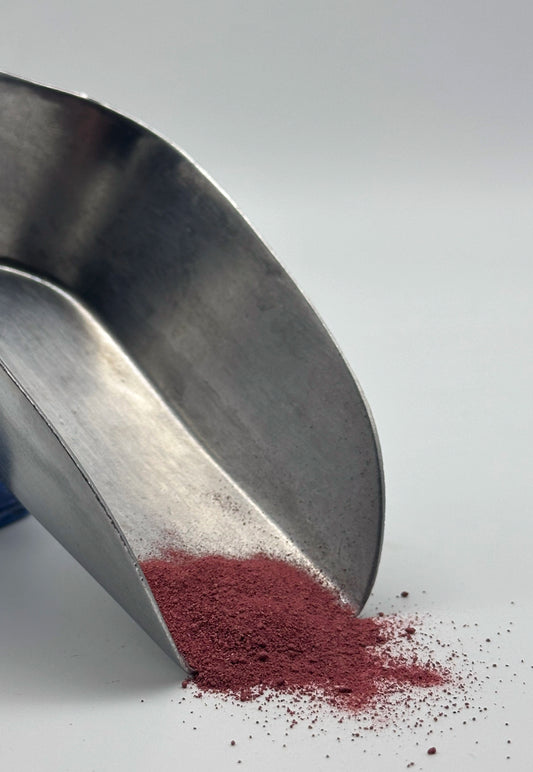
Maybe because beet is such an embodied plant. It grows down into the earth, storing its nourishment beneath the surface, while carrying this extraordinary blood-red color that stains absolutely everything it touches (ask anyone who has worked with beet powder in an apothecary). Beet root contains naturally occurring dietary nitrates that the body can convert to nitric oxide, which is part of why beet has become so well known for supporting healthy circulation and blood flow. It also brings folate, potassium, fiber and those gorgeous betalain pigments that give it its deep ruby color.
But ritually, I am less interested in telling you what somebody centuries ago decided beet “symbolized” and more interested in paying attention to what the actual plant is showing us.
Here is a root growing beneath the soil, gathering and storing nourishment where we cannot see it. Above ground there are leaves, but the treasure is forming underneath. And then you cut it open and there is this astonishing red that looks like blood and life itself. At the Equinox, when the natural world is beginning to move its energy away from outward expression and toward roots, storage, soil, and what happens beneath the surface, that feels like medicine to me.
Root down. Nourish what is beneath the surface. Trust what is growing where you cannot yet see it.
And because plant medicine is always more interesting to me when we actually work with the plant rather than just talk about it, I wanted to give you a little Equinox recipe right here.
Equinox Beet Elixir
This is somewhere between a tea and a tonic, and I wanted it to taste like the actual transition we're making. Hibiscus still carries some of that bright, tart energy of summer, while beet brings us down into the roots and cardamom and ginger begin introducing the warmth our bodies start craving as the weather cools. Honey softens the whole thing and, of course, brings its own connection to the abundance and work of the summer season.
For one generous mug, use about 1 teaspoon beet root powder, 1 tablespoon dried hibiscus, 3–4 lightly crushed green cardamom pods, and 2–3 thin slices of fresh ginger. Add them to about 12 ounces of water, bring just to a boil, lower the heat and gently simmer for about 10 minutes. Strain into your favorite mug and add honey to taste once it has cooled slightly.
It will be this extraordinary deep ruby-red color, tart from the hibiscus, earthy from the beet, aromatic from the cardamom, gently warming from the ginger and softened by the honey. And yes, beet powder being beet powder, there will probably be a little sediment. We are herbalists. We can survive sediment.
You could simply drink it because it is delicious, but for the Equinox I would make it part of the ceremony.
Take a walk sometime around the Equinox and gather a few fallen leaves that catch your attention. Bring something from the harvest into your home—corn, grain, squash, a beautiful root vegetable, something from your garden or something grown where you live. Add some calendula flowers and rosemary to your table or sacred space, perhaps a small bowl of hawthorn berries, and light burgundy, orange, or gold candles. Make your Beet Elixir, sit down with it, and give yourself enough time to actually arrive.
Begin with your harvest. Allow yourself to acknowledge what came to fruition without immediately qualifying it with everything you haven't done yet. Write about it, paint it, talk about it around the table, or simply sit quietly and remember. Give thanks in whatever way makes sense to you—to Creator, Spirit, God, the Earth, your ancestors, yourself, your community, or all of the above. Then begin noticing where you feel out of balance. Not where some book, coach, Instagram post, or productivity system says you should be in balance, but where YOU actually feel it.
Check in with your physical, emotional, mental, energetic, and spiritual bodies. Notice what has become too loud and what has become too quiet. Ask yourself where you have become overly external and what your Inner Wisdom has been whispering that you keep pretending you can't hear. Then, instead of making another enormous self-improvement plan, listen for what actually wants tending. Maybe you need more rest or more movement. Maybe you need to nourish your body differently. Maybe you need to call someone, spend less time online, make more art, be with your community, spend some time alone, ask for help, say no to something, or finally say yes.
Maybe you need to put a date on your calendar to literally do nothing.
Because doing nothing is doing something.
Years ago I described autumn as my annual tune-up and tire balance so I can run smoothly through the holiday season and winter, and apparently I still agree with myself. My own recalibration at this time of year tends to have much less to do with what I want to do and much more to do with how I want to feel and be as I move into the darker part of the year.
I don't want to become so internally focused that I disconnect from the world, but I also don't want to become so externally focused that I lose myself inside it. I want connection without constant reactivity. I want to care deeply without believing I have to personally carry everything. I want to participate in my community, tend the people around me, and pay attention to what is happening in the world while still being able to hear my own Inner Wisdom. And I want to know when action is actually needed and when I need to sit down with a cup of tea and let something remain unfinished.
Perhaps that is the balance I am interested in now.
Not standing perfectly still at the midpoint, but learning how to move with the changing weight.
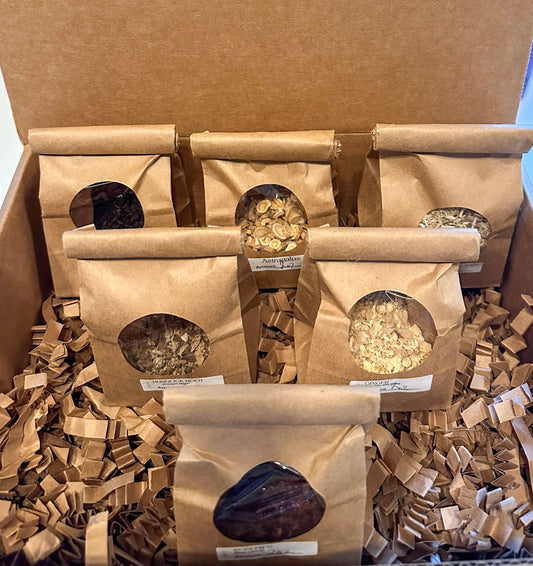
This is also very much the spirit behind our Seasonal Alchemy: Fall Recipe Book and Seasonal Alchemy: Fall Apothecary Box at Wise Roots Apothecary. I didn't want to create just another collection of “fall herbal recipes.” I wanted to create something that lets the season move through your kitchen, your body, your home, and your rituals. There are warming teas and tonics, elderberry syrup, fire cider, herbal honey and oxymel, nourishing soups and autumn foods, body care and ritual bathing, along with practices for remembrance, harvest and letting go. The Fall book even carries rosemary into our Rosemary, Sage & Garlic Roasted Roots and calendula into a beautiful Calendula & Rose Body Oil, so some of the plants on our Equinox table can continue accompanying us through the season. The box contains six herbs that will bring the recipes to life.
But really, whether you ever make a formal Equinox altar or ritual at all, the invitation is much simpler.
Pay attention to the turn of the season. Celebrate what grew. Feed yourself. Thank the people who helped you get that food on the table. Notice what your body is asking for as the light changes. Listen for what needs recalibrating and make some room for what needs to happen beneath the surface.
The Equinox isn't asking us to achieve perfect balance before the light begins to fade.
It is simply offering us a moment to notice where we are standing before we take the next step.
And perhaps, with a ruby-red cup of beet, hibiscus, ginger, cardamom and honey warming our hands, we can be still long enough to hear the whisper:
Come back home to yourself.